
SNOW. Work together
CHESNEY SNOW · ARTS EDUCATION
Beatboxing,
Hip-Hop &
Theater Workshops
Workshops · Artist residencies · Performances
Find a voice. Build a rhythm. Create together. Bring the human voice, storytelling and ensemble work into your school, university or community organization.
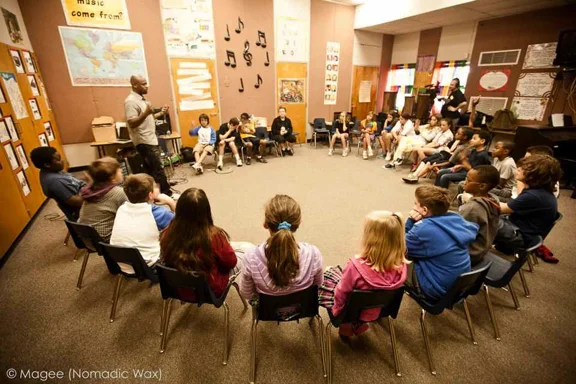
Learning through voice, rhythm and creative collaboration.
Photo © Magee (Nomadic Wax)
A Drama Desk Award-winning actor, American beatboxer and Princeton educator, Chesney connects a career in performance with sustained work in schools, universities and community settings.
VOICE & RHYTHM
Beatboxing and the human instrument.
Beatboxing uses the voice to create rhythm, percussion and other musical sounds. In a learning setting, it offers a practical way to explore how sound is made and how individual ideas become a shared composition.
A workshop can bring together vocal exploration, rhythmic patterns, improvisation and group listening. Participants can investigate the relationship between breath, sound and musical choice, then consider how a rhythm changes when another voice enters. The work invites curiosity about each person’s sound and responsibility for the sound of the group.
For a participatory workshop, performance or longer artist residency, the format begins with a conversation about the audience, setting and purpose.
CULTURE & STORY
Hip-Hop education through voice and story.
Hip-Hop provides a meeting place for musical invention, language, identity and cultural history. Chesney’s practice connects his work in American beatbox culture with teaching that asks people to listen closely, take creative risks and make choices about the stories they tell.
His experience includes co-founding the American Beatbox Championships and executive producing the documentary American Beatboxer. He also serves on the board of the Hip-Hop Education Center.
For a school or community organization, this background can support a conversation about bringing beatboxing and storytelling into an existing arts program or developing an experience around a particular theme.
TEXT & PERFORMANCE
Theater education and oral interpretation.
Acting, poetry, movement and oral interpretation invite participants to consider how meaning changes through rhythm, emphasis, attention and physical presence.
Chesney’s work ranges from originating Boxman in Broadway’s In Transit to curating When Pages Breathe at Princeton. That series brings literature and archival documents into performance and public discussion.
An educational engagement can explore the journey from written text to spoken performance, the development of an ensemble, or the relationship between personal storytelling and theatrical form. Share your group’s experience and learning goals so the focus can be developed for the setting.
POETRY · MOVEMENT · MUSIC
Choreopoem and collaborative creation.
In Chesney’s choreopoem practice, poetry, movement, music and theatrical storytelling share the stage. Spoken language and beatbox rhythms can work alongside dance and live instruments to give lived experience a theatrical form.
Explore The Unwritten Law, his autobiographical choreopoem co-created with director and choreographer Rebecca Arends, and Soil Beneath, his Primary Stages commission examining race, class and American life.
These works offer a starting point for conversations with educators and presenters about original performance, storytelling and collaboration.
EMPATHY & SHARED STORIES
Kindness Is My Superpower.
For organizations interested in empathy, kindness and shared stories, The KIMS Project offers a related starting point. Founded and led by Chesney, its workshop was created with school counselor Katie Maxwell McIntyre.
Explore the Kindness Is My Superpower program to learn more about its storytelling and beatboxing practice for schools, families, nonprofits and workplace teams.
LET’S WORK TOGETHER
Plan a workshop or residency.
Chesney has led workshops and masterclasses at institutions including Harvard, The Juilliard School and New York University. His teaching experience spans classrooms, theaters and community organizations.
To discuss an engagement, share:
- Your school or organization and location.
- Participants’ ages, approximate group size and experience.
- Themes or learning goals.
- Preferred dates and whether you are considering a workshop, performance or residency.
- Available space, access needs, and project budget or funding status.
These details help establish an appropriate scope and the practical arrangements.
Discuss a workshop or residency