Broadway production footage · The Tony Awards, 2017.
From the first production to Broadway
More from the video archive.
In Transit at Primary Stages
An original Primary Stages video, included in BroadwayWorld’s June 2016 retrospective on the Off-Broadway production.
Primary Stages
Watch in the video archiveFour Days Home
A musical excerpt from the Primary Stages archive, published by Primary Stages and included in BroadwayWorld’s 2016 video retrospective.
Primary Stages
Watch in the video archiveDeep Beneath the City — the cast in rehearsal
The opening number in a pre-Broadway music video, released October 12, 2016.
In Transit / BroadwayWorld · 2016
Watch in the video archiveThe people behind the sound
Selected production credits.
Book, music and lyrics: Kristen Anderson-Lopez, James-Allen Ford, Russ Kaplan and Sara Wordsworth.21
Off-Broadway · 2010
- Production
- Primary Stages at 59E59 Theaters
- Director
- Joe Calarco
- Boxman
- Chesney Snow
- Sound design
- Jon Weston
Broadway · 2016–17
- Theater
- Circle in the Square
- Director / choreographer
- Kathleen Marshall
- Vocal arrangements
- Deke Sharon
- Music supervisor / conductor
- Rick Hip-Flores
- Sound design
- Ken Travis
- Boxman, alternating
- Chesney Snow and Steven “HeaveN” Cantor
Broadway production record21
Read further
Sources & archive notes.
Contemporary reporting, production records, interviews and the artist’s firsthand account. Photograph credits and original photo galleries accompany the images above.
- In Transit · Music Theatre International, licensed Broadway edition
- Mark Blankenship, Making an A Cappella Musical · TDF · September 30, 2010
- Della Hasselle, New Musical In Transit Mimics Life in the Subway · DNAinfo · October 7, 2010
- In Transit, New A Cappella Musical, Opens on Broadway · Playbill · December 11, 2016
- Allison Considine interviews Kristen Anderson-Lopez · American Theatre · November 8, 2016
- Bringing a Pitch Perfect Ear to Broadway · Playbill · Deke Sharon interview
- Stacy Lambe interviews Kristen Anderson-Lopez · Entertainment Tonight · December 9, 2016
- Ruthie Fierberg, How Do You Write an A Cappella Musical? · Playbill · December 9, 2016
- Frank Rizzo, Broadway review of In Transit · Variety · December 11, 2016; author’s archive
- Philip Boroff, In Transit Seeks Express Train to Broadway · Broadway Journal · March 21, 2016
- In Transit · Music Theatre International, official author and original-production billing
- Andrew Gans, In Transit Begins York Theatre Company Run · Playbill · August 8, 2008
- In Transit · 59E59 Theaters, original Primary Stages production archive
- Drama Desk Award Nominations Announced · Backstage · 2011 special ensemble honor
- What to Expect From the Broadway-Bound In Transit · Playbill · 2016
- In Transit final performance announcement · New York Theatre Guide · 2017
- From Pitch Perfect to Broadway, He’s Vocal About A Cappella · The New York Times, syndicated by Malay Mail · November 28, 2016
- Richard Seff, In Transit at Circle in the Square · DC Theater Arts · December 16, 2016
- Chesney Snow · firsthand recollection for this archive, November 2026
- Michael Dale, In Transit Sets New York Stories to Glorious A Cappella Vocals · BroadwayWorld · December 11, 2016
- In Transit · Internet Broadway Database, original Broadway production credits
- Kristen Anderson-Lopez · Music Theatre International, author-approved biography
- James-Allen Ford · Music Theatre International, author-approved biography
- Russ Kaplan · Music Theatre International, author-approved biography
- Sara Wordsworth · Music Theatre International, author-approved biography
- Marc Hershberg, Why In Transit Failed to Move Audiences · Forbes · June 6, 2017
- Robert F. Smith · Internet Broadway Database, producer credit
- Carnegie Hall Trustees Elect Robert F. Smith Chairman · Symphony / League of American Orchestras · June 3, 2016
- Primary Stages Gala honors Janet and Marvin Rosen · Playbill · October 13, 2017
- 2016–2017 Broadway End-of-Season Statistics · The Broadway League · May 23, 2017
- Showtune Showdown: Thirteen Musicals in a Historically Competitive Year · Broadway.com · April 2017
- 2017 Tony Award nominations · Official Tony Awards archive
- Tony Awards Eligibility for 2017, Part 2 · Official Tony Awards · January 26, 2017
- 2011 Drama Desk nominations and separate special ensemble award
- 2011 Drama Desk full results
- 2011 Lucille Lortel nominations; four for In Transit
- 2011 Lucille Lortel recipients by show
- 2011 Drama League nomination announcement, including full performer dais
- 2011 Drama League results
- 2010–11 Outer Critics Circle nominations
- 2011 Outer Critics Circle results
The work continues
One voice.
Many ways to connect.
Explore Chesney’s work across theater, music, education and community.
The complete career Start a conversationThe making of the musical · In Transit Broadway / Comcast, 2016.
SNOW. Work together
A musical made of human voices
IN TRANSIT

Chesney Snow as Boxman, center, with the Broadway company of In Transit. Joan Marcus’s production photograph accompanies Elite Daily’s March 2, 2017 profile of Snow.
A City Made of Voices
The seventeen-year journey of In Transit, the intricate work of building an a cappella book musical, and Chesney Snow’s place at its rhythmic center.
01The proposition
Listen to the people on the platform
A subway platform gathers people who have reasons to be somewhere else. In Transit asked its audience to listen to them before the train arrived. Its aspiring artists, unsettled professionals and accidental confidants inhabited a New York made from voices: the ensemble supplied melody, accompaniment, rhythm and atmosphere. Broadway’s first a cappella musical gave its stories of ambition a revealing musical condition. Whenever someone stepped forward to sing about an individual life, other people had to keep that life’s surroundings audible.12
Chesney Snow’s Boxman occupied the meeting point between the city and its score. A beatboxer could belong naturally on a subway platform while supplying the percussion beneath the people passing through it. In the 2010 production, DNAinfo identified Snow as the company’s only percussionist. His presence made the show’s governing idea tangible: an apparently ordinary encounter with another New Yorker could become the mechanism that allowed everyone else to be heard.3
By the time In Transit opened at Circle in the Square on December 11, 2016, that idea had been in development for seventeen years. The journey matters because it records a difficult act of theatrical invention. An all-vocal musical needed a story worth following, arrangements that could survive continuous performance, and a company capable of acting inside its own accompaniment. Getting those elements onto Broadway required artistic persistence and sustained producing commitment. This archive follows the work behind that arrival, and the place Snow held within it.456
021999–2016
Seventeen years between stations
The first song dates to 1999. Kristen Anderson-Lopez and James-Allen Ford were paired in the BMI Lehman Engel Musical Theatre Workshop, where a ten-minute assignment became an early version of the project. Their a cappella group, Bob Ross Juice Box, connected them with Russ Kaplan and Sara Wordsworth. On September 13, 2001, the four met at Ford’s apartment and committed themselves to a love letter to New York. The project’s origins therefore contain two impulses: the pleasure of making music together and the need to recognize a wounded city through the lives within it.78
An earlier incarnation, Along the Way, appeared at the 2003 New York International Fringe Festival and at the New York Musical Theatre Festival in 2004. Development continued at the Eugene O’Neill Theater Center in 2008, followed that August by the York Theatre Company’s NEW2NY staged concerts. These were working stages in the life of a changing musical. The score, characters and theatrical structure had to be heard together before the writers could know what their experiment could sustain.9101112
Primary Stages brought In Transit to 59E59 in 2010, directed by Joe Calarco. Snow joined Steve French, Celisse Henderson, Hannah Laird, Graham Stevens, Denise Summerford and Tommar Wilson in a company of seven, multiplying themselves across the show’s New Yorkers. The production earned a special Drama Desk award for its ensemble the following year. That recognition was particularly apt for a piece in which supporting someone else’s scene could mean sustaining its actual musical foundation. Broadway nevertheless remained six years away.1314
The form made development unusually laborious. Anderson-Lopez explained to Playbill that a reading required many voices learning an approximately 300-page score; a pianist and a few lightly rehearsed performers could not adequately demonstrate it. The practical problem ran deep. Before a producer could hear the proposed experience, a temporary company had to achieve enough musical cohesion to create it. Revision then asked those singers to absorb another configuration of interlocking parts. The long journey was also a succession of people investing rehearsal time in something that could only reveal itself through collective effort.15
The route to Broadway
Seventeen years,
many stops.
- 1999
The first song
The project begins during the writers’ BMI workshop and Bob Ross Juice Box years.7
- 2001
A promise to New York
On September 13, the four writers meet at Ford’s apartment and commit to a love letter to their city.7
- 2003–04
- 2008
- 2010
Primary Stages
The seven-person production reaches 59E59 under Joe Calarco’s direction, with Snow as Boxman.13
- 2016
Broadway
Previews begin November 10. Opening night follows December 11 at Circle in the Square.4
- 2017
The recording and the archive
The run concludes April 16; the Broadway cast recording follows, preserving the company’s work.16
03Inside the form
When the cast is also the orchestra
A book musical uses scenes and songs to move characters through a story. In Transit made that familiar task an orchestration problem as well. Its writers described revising arrangements around costume changes, entrances and the need for audiences to see who was singing intelligible words. A tenor leaving the stage could change the available sound. A quick switch between characters could require a different distribution of voices. The book, staging and musical arrangement had to keep answering one another; each department was working with the same performers.8
The performers’ attention was equally divided. In TDF’s account of the Off-Broadway production, Denise Summerford described the concentration required to retain pitch, blend with colleagues and remain musically active while offstage. An actor could finish a scene without finishing the work that supported it. This helps explain the distinctive pressure of the ensemble: listening was a continuous responsibility. The company had to preserve a shared musical environment while individual characters struggled, flirted, argued or pursued an opportunity inside it.2
For Broadway, Deke Sharon’s arrangements and Rick Hip-Flores’s musical supervision operated within a carefully coordinated technical system. Contemporary reporting described performers singing through backstage travel and costume changes, using in-ear monitors to hear the vocal layers and Hip-Flores’s cues. The sound reached the audience through sophisticated theatrical mediation. What began in a throat still had to be balanced, timed and made legible throughout the room. The human scale of the source made that engineering more consequential: every change in placement or emphasis could affect both harmony and storytelling.17
Sharon also emphasized the challenge of finding the necessary vocal range and sustaining a full-length score eight times a week. The ensemble had to contain contrasting colors without losing its ability to function together. That creates an illuminating way to understand the show’s significance. A cappella makes dependence audible. The foreground belongs to one person for a moment; its depth, movement and stability belong to others. In Transit gave that exchange a dramatic setting in a city where strangers are constantly, often unknowingly, making one another’s lives possible.6
04The continuity of a performer
Chesney Snow, at the center of the pulse
Snow was the only performer from the 2010 Primary Stages cast to continue into the 2016 Broadway production. Richard Seff’s contemporary review explicitly recorded that continuity. Around him, the production had changed directors, expanded its vocal forces and acquired a new physical life. His return connected two distinct versions of the musical through the practical knowledge of one performing body: someone who had already learned how Boxman’s presence could organize the audience’s relationship to the show.18
For this archive, Snow describes his involvement as helping to craft the musical’s percussive sound and the character through whom that sound reached the audience. His account locates creative work inside performance itself. A rhythmic pattern has an attack, a weight and a sense of forward motion; a character has an attitude toward the people sharing his space. Bringing those decisions together means shaping how a scene feels as well as how its beats are counted. Snow’s contribution lives in that conjunction of musical invention and characterization.19
The contemporary record establishes how central the task was. DNAinfo’s description of Snow supplying the original company’s percussion puts him within the score’s essential structure. Michael Dale’s Broadway review likewise identifies Boxman as the grounding force beneath its varied musical styles. The dramatic opportunity follows from that position: a subway performer who might otherwise remain at the edge of someone else’s commute becomes the person setting its pace. The audience is invited to recognize skill, attention and authority in a figure it could easily pass by.320
On Broadway, Snow alternated as Boxman with Steven “HeaveN” Cantor. Their work sat within a collaboration whose formal credits name Anderson-Lopez, Ford, Kaplan and Wordsworth for book, music and lyrics; Sharon for a cappella arrangements; Kathleen Marshall for direction and choreography; and Hip-Flores for musical supervision. Those credits describe different forms of expertise meeting in one audible result. For Snow, the achievement was to bring the specificity of a beatboxer’s instrument into that structure while preserving the immediacy of a character encountered on the street.2119
At the heart of our show is a beat-boxer.
05Four writers, one musical
The careers that grew around the work
The authors’ shared billing captures a defining feature of In Transit: all four receive credit across book, music and lyrics. Anderson-Lopez described a democratic room in which scenes passed between colleagues for revision and ideas could come from any of them. Their long friendship provided continuity as their professional lives expanded. The musical endured alongside those careers, retaining the questions and relationships that had first brought the writers together.115
Anderson-Lopez’s success with Robert Lopez on Frozen gave the project a writer whose work had reached an extraordinary international audience before In Transit arrived on Broadway. Their later achievements include the Oscar-winning “Remember Me” from Coco and the Emmy-winning “Agatha All Along” from WandaVision. Seen retrospectively, In Transit belongs to the earlier laboratory of that career: a sustained inquiry into how a song can make an emotional predicament clear enough for strangers to recognize.22
Ford brought extensive a cappella experience, including singing or directing with Yale’s Mixed Company and Whiffenpoofs, Columbia’s Redline and Bob Ross Juice Box, alongside recognition from BMI’s Harrington Award. Kaplan’s work extends through theatre and jazz, including The Ulysses Cycle and projects with immersive theatre company Third Rail Projects. Their histories suggest complementary musical habits: precision about the internal life of a vocal group, and curiosity about how a score can organize an audience’s experience.2324
Wordsworth’s work includes stage adaptations for Disney Cruise Line and the licensed Frozen JR. and Frozen KIDS editions, as well as collaborations with Kaplan such as Dear Albert Einstein. She and Kaplan also helped produce the In Transit cast recording. These are careers concerned with how theatrical writing travels: between audiences, production scales and forms of presentation. Together, the four writers gave In Transit a durable collaborative identity, even as its arrangements, staging and company changed.2524
06The people who carried the risk
Janet and Marvin Rosen’s commitment
The move to Broadway needed people willing to take responsibility for an unfamiliar proposition. Janet Rosen had supported the 2010 production and held the rights when Broadway Journal interviewed her in March 2016. She was preparing to lead the show onto Broadway after years of development. The courage in that decision is specific: backing a work whose musical method required explanation, whose success depended on intricate ensemble labor, and whose intimacy had to register as an attraction in a commercial theatre.10
Marvin Rosen’s later account shows the practical commitment behind that belief. He brought investors into the production, and the team worked to build audiences through word of mouth and discounted access. After the closing, he spoke candidly about the limits of what they could continue to finance, while remaining proud of having produced it. His description of the experience as “one of the thrills of my life” gives the story a human measure. Producing involved both the obligation to assess a business and the willingness to care deeply about the work it supported.26
Robert F. Smith, founder of Vista Equity Partners, was among the show’s credited producers and investors. His participation carries a wider cultural resonance. In 2016 he also became the first African-American chairman of Carnegie Hall. Read alongside that landmark appointment, his involvement in In Transit places a prominent Black cultural leader among the people enabling an experiment in what Broadway could sound like. The combination makes visible an enabling condition of artistic experimentation: access to capital and to people willing to put their institutional experience behind a new idea.272628
Primary Stages honored Janet and Marvin at its October 2017 gala, where the musical’s writers and members of its Broadway company, including Snow, paid tribute to them. The occasion offers a fitting perspective on their contribution. The commercial run had ended, yet the relationships and artistic work it made possible remained part of a living theatre community. The Rosens’ vision can be measured in that continuity: they helped a demanding, long-developing idea become an experience that performers and audiences could actually share.29
We are ready to take it to Broadway.
07Broadway, 2016–17 and beyond
An arrival in a crowded season
In Transit arrived in an exceptionally crowded field. The Broadway League recorded thirteen original musicals opening during the 2016–17 season. Contemporary Broadway.com coverage identified that as the largest new-musical field in thirty-six years. Calling the season unusually competitive is therefore more than retrospective consolation. A new production was seeking recognition amid an unusually large number of other new works, each asking audiences and critics to discover its particular reason for being there.3031
The four eventual Best Musical nominees—Dear Evan Hansen, Come From Away, Natasha, Pierre & the Great Comet of 1812 and Groundhog Day—indicate how much attention was concentrated elsewhere. In Transit received no Tony nominations, although it was eligible. The pressure extended beyond awards: established attractions and major revivals were also competing for an evening of a visitor’s time. This context helps explain the scale of the task facing the producers. It cannot, by itself, explain the choices of every ticket buyer or the outcome of the run.323331
Critical responses also reveal a productive tension within the work. Frank Rizzo’s review admired its vocal beauty while finding its stories familiar. That distinction deserves room in an honest archive: originality of musical form does not guarantee that every observer will experience equal novelty in the drama. The production closed on April 16, 2017, after 145 regular performances. Its short Broadway life belongs in the record alongside the achievement of getting an untested form onto that stage.916
The cast recording, released in 2017, preserved the Broadway score beyond the run. The musical’s availability through Music Theatre International now allows other companies to undertake its unusual demands. An archive can hold these different kinds of evidence together: the photographed staging, the recorded voices, the credits and the work’s continuing potential for performance. Each offers another way to encounter the experiment and to understand the labor that made it possible.161
Snow’s place within that history is unusually precise. As the performer linking the Primary Stages and Broadway casts, he connects both productions through a practice that cannot be reduced to a photograph or a list of credits. Breath, timing, articulation and the attention paid to another performer must be made again in the moment. In Transit built a city from that kind of shared activity. At its rhythmic center, Snow made the body audible as an instrument—and made the person producing the sound impossible to overlook.1819
Production photographs / Off-Broadway · Primary Stages · 2010
The first New York production.

The 2010 Primary Stages production of In Transit, directed and staged by Joe Calarco, with a subway set by Anna Louizos.

Denise Summerford and company in the 2010 Primary Stages production.
Production photographs / Broadway · Circle in the Square · 2016–17
A bigger room. An entirely human sound.

Margo Seibert and the Broadway company of In Transit, 2016.

Erin Mackey and the Broadway company of In Transit, 2016.

Chesney Snow and the company take their opening-night bows at Circle in the Square on December 11, 2016. Published by BroadwayWorld on December 12.
Recognition / The original 2010 production
The complete awards record.
Ten competitive nominations across four organizations in 2011, and a special Drama Desk award for the ensemble.
2011 Drama Desk / Special award
Outstanding Ensemble Performance
Awarded to the cast of In Transit
Drama Desk Awards
4 nominations| Category | Nominee | Result |
|---|---|---|
| Outstanding Musical | In Transit | Nominated3435 |
| Outstanding Book of a Musical | Kristen Anderson-Lopez, James-Allen Ford, Russ Kaplan and Sara Wordsworth | Nominated35 |
| Outstanding Director of a Musical | Joe Calarco | Nominated35 |
| Outstanding Sound Design in a Musical | Jon Weston | Nominated35 |
Lucille Lortel Awards
4 nominationsDrama League Awards
1 nominationOuter Critics Circle Awards
1 nominationThe nominations and ensemble honor above recognize the original Primary Stages production. The 2016–17 Broadway production is a separate production record.
Around the show
Familiar faces.
A shared destination.
Opening-night arrivals and backstage visits, preserved in the contemporary photo record.
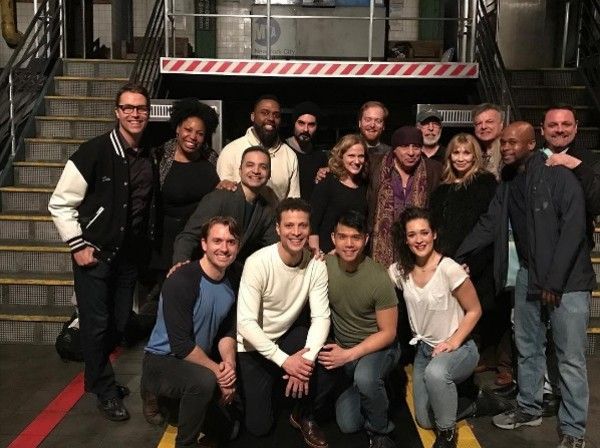
Steven Van Zandt visits the Broadway company. The backstage photograph was published April 10, 2017.
Steven Van Zandt visits In Transit
A backstage visit reported April 10, 2017, with photography shared by the production’s Instagram account.
Explore the photo archive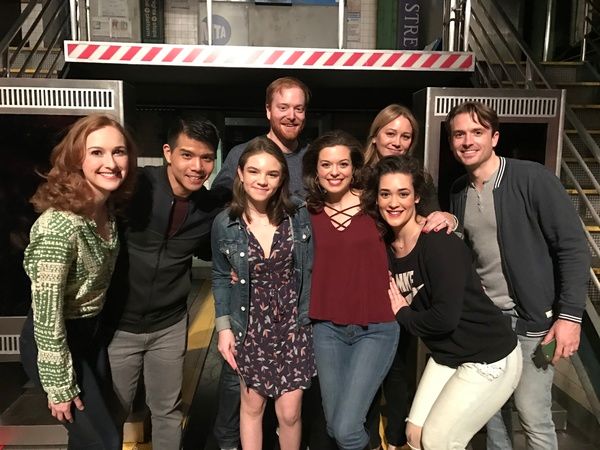
Christine Taylor and Ella Olivia Stiller with the In Transit company. Published April 3, 2017, following their weekend visit.
Christine Taylor and Ella Olivia Stiller
Their April 2017 visit, documented with a company photograph courtesy of Colgan McNeil.
Explore the photo archive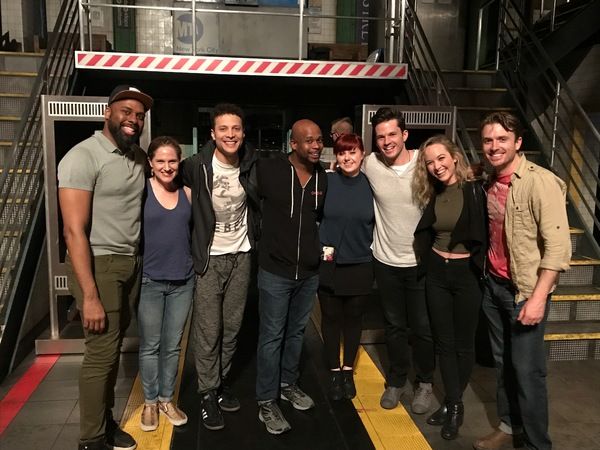
Pitch Perfect performer Kelley Jakle visits the cast on April 11, 2017—a meeting of two a cappella worlds.
Kelley Jakle visits the company
The Pitch Perfect performer attended the April 11, 2017 performance.
Explore the photo archiveBill and Hillary Clinton attend
Playbill documents the former president and former secretary of state’s February 1, 2017 visit, audience welcome and trip backstage. Published February 2, 2017.
Explore the photo archiveThe opening-night arrivals
The December 11, 2016 opening-night gallery includes Mario Cantone, Tommy Tune, Michael Cerveris, Robert Lopez and Kristen Anderson-Lopez, and other theatre guests. Photography by Joseph Marzullo/WENN; view in the source gallery.
Explore the photo archiveThe archive, in motion
Hear the human orchestra.
Performance footage and conversations from the show’s Broadway journey.